What it actually does.
AiFlow 8.2.0, described capability by capability. Every page below ends with what that capability deliberately does not do, because the constraint you find after buying is the expensive one.
Nine parts, one deployment.
- The conversation→
A conversation you can interrupt.
One session engine behind an embeddable widget and a real phone number. Voice is full duplex, so a visitor can cut in mid-sentence the way they would with a person.
Voice, video, and text
- Reaching people→
It answers, and it calls back.
Map a real number to an agent, and let other systems trigger a call when something happens. Both directions run through a durable queue that survives a restart.
Telephony and outreach
- Beyond conversation→
It can act with nobody on the line.
Post an event from any system that speaks HTTP, and conditions you configure decide what happens: a call, a WhatsApp message, both, or a task the agent completes without ringing anyone.
Automations
- What it knows→
Give it your documents, not a prompt.
Upload files or point it at a URL for what the agent should know. Write short procedures as skills for what it should do. Both change without a redeploy.
Knowledge and skills
- Beyond one model→
A live call can hand work to Claude.
The voice runs on Gemini because it has to. Longer, multi-step work can be delegated to an Orchestrator running on whichever model you prefer, and the answer comes back in the agent voice.
Orchestrators
- Reaching your systems→
It speaks the protocol, in both directions.
Most platforms hand-build one connector per service, so you wait for whichever integration is next on a roadmap. AiFlow implements MCP itself, which means a compliant server works the day it ships.
Integrations
- More than one deployment→
One deployment can call another.
A group with several brands, regions, or subsidiaries ends up with several deployments. Federation lets them delegate work to each other on purpose, with the loop and abuse problems solved rather than left to policy.
Federation
- Proving it works→
Grade a change before a caller ever hears it.
Build a dataset of real scenarios and the criteria a good answer should meet, then run a candidate prompt against it and watch a live call while it happens.
Evaluations and quality
- The boring, essential part→
Built for the questions procurement asks.
Single tenant by construction, with the controls a regulated buyer expects already present rather than on a roadmap.
Security and compliance
Or watch the whole thing run.
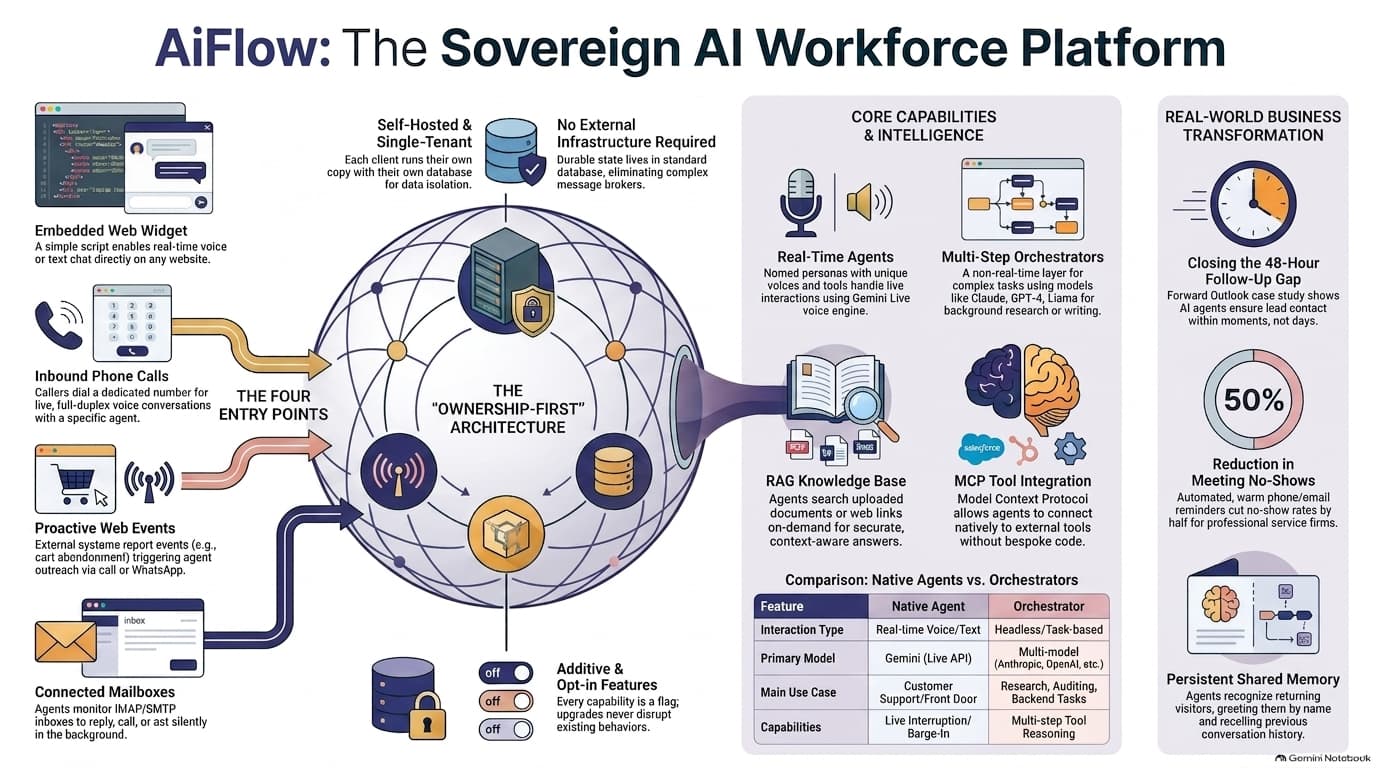
Four ways in, the same agent behind all of them.
AiFlow Session Engine
Shared state memory & unified conversational context across every channel. Interruption handling and tool executions run seamlessly in realtime.
{"stream": "24kHz Opus", "duplex": true, "screen_share": "active"}