Reaching people
It answers, and it calls back.
Map a real number to an agent, and let other systems trigger a call when something happens. Both directions run through a durable queue that survives a restart.
What the capability actually does.
Inbound, with a queue
Several agents can share one number, with callers routed to whoever is free. When everyone is busy the caller gets a spoken hold rather than a rejection, and is connected when a line frees up.
It checks the number before it dials
Every outbound call is screened against Twilio Lookup first. An invalid number, or a line type you have chosen to block, fails without placing a call. A Lookup error lets the call through rather than blocking it, because a screening outage should not stop your outreach.
It knows when it reached a voicemail
Answering machine detection can be turned on per agent. A call that reaches voicemail or a fax is hung up and recorded as no answer with the reason, instead of leaving a recording nobody hears and counting it as a success.
Verify who you are talking to
A one-time passcode over SMS or voice, through Twilio Verify, before the agent discusses anything sensitive. Separate from the pre-shared code an internal staff member uses.
Warm transfer, optionally routed
When a conversation needs a human, the agent rings a number you configure and briefs whoever picks up with a spoken summary. With TaskRouter, the handoff creates a routing task and dials the worker it assigns, falling back to the fixed number if nobody is assigned in time.
Calls survive a restart
The outbound queue lives in the database rather than in memory, so a call queued when the process stopped is placed when it comes back. There is no broker to run.
The screens this happens on.
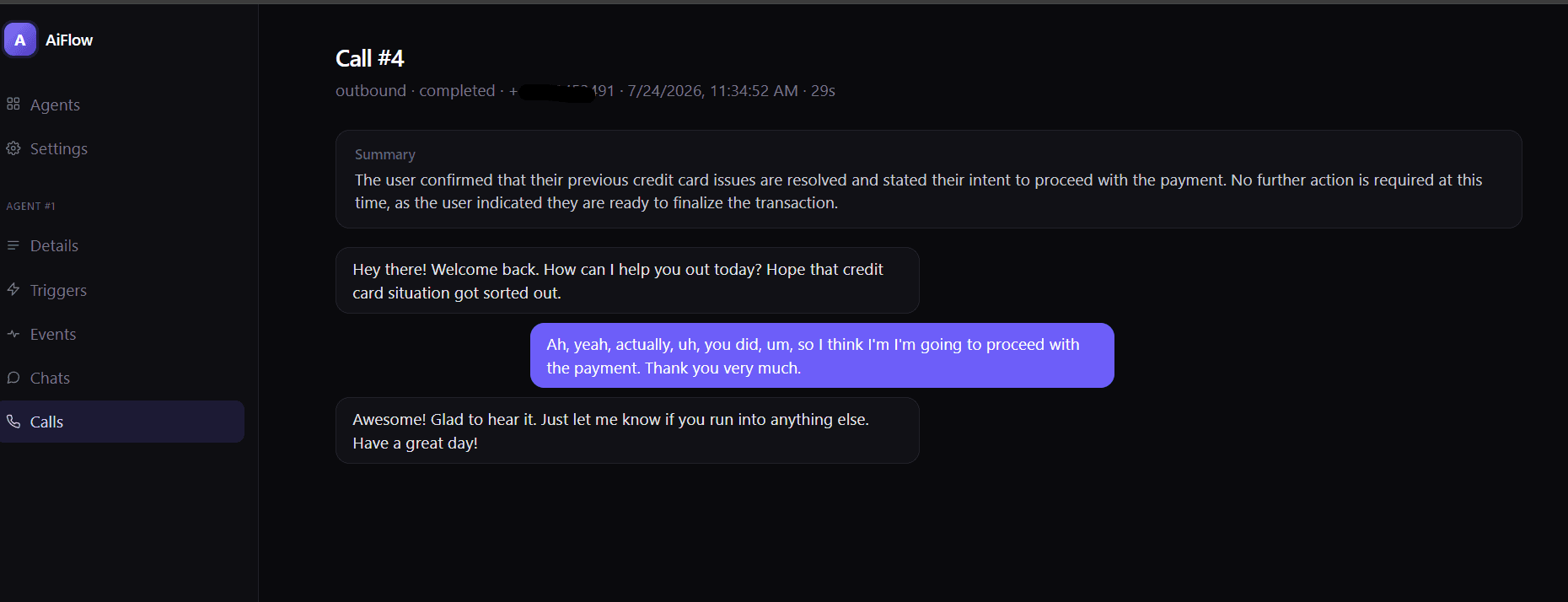
Every call keeps a full transcript
Every session becomes a Call record, whichever way it arrived. The summary at the top is written by the agent as the conversation wraps up, and the transcript beneath it is written turn by turn while the call is still running rather than reconstructed afterwards. A call placed by a trigger keeps a link back to the event that caused it.
- Phone, widget, and email sessions all record the same way
What it deliberately does not do.
- Telephony and WhatsApp go through Twilio, so a Twilio account is required for anything involving a phone number. The widget needs only a Gemini key.
- Per-call quality metrics need Voice Insights Advanced enabled on your own Twilio account, and TaskRouter routing needs a TaskRouter workspace you configure.
- WhatsApp business-initiated messages need a pre-approved template, which is WhatsApp policy rather than an AiFlow limitation.
- Answering machine detection is Twilio’s verdict, and no such detection is perfect. It is off by default.