The boring, essential part
Built for the questions procurement asks.
Single tenant by construction, with the controls a regulated buyer expects already present rather than on a roadmap.
What the capability actually does.
Single tenant, by construction
Each deployment is one business with its own database and credentials. There is no shared runtime, so a customer conversation cannot reach another customer even in principle.
An audit log that answers why
Every meaningful admin action is recorded with who did it and when, including every call an outside MCP client makes. Combined with the event log and per-turn transcripts, you can trace why the system called a particular person.
Retention and erasure
Set how long transcripts, events, and messages are kept, and change it without a restart. A single request erases everything tied to a phone number or email address. Both ship in every plan including the free one.
Least privilege for machines too
An API key carries one scope per capability rather than a single all-or-nothing grant, and there is deliberately no wildcard. A key that only needs to read transcripts cannot place a call.
Hardened against its own configuration
Every admin-supplied URL is checked before it is called, with the resolved address pinned to defeat DNS rebinding. Credentials are encrypted at rest. Webhook deliveries are signed.
The screens this happens on.
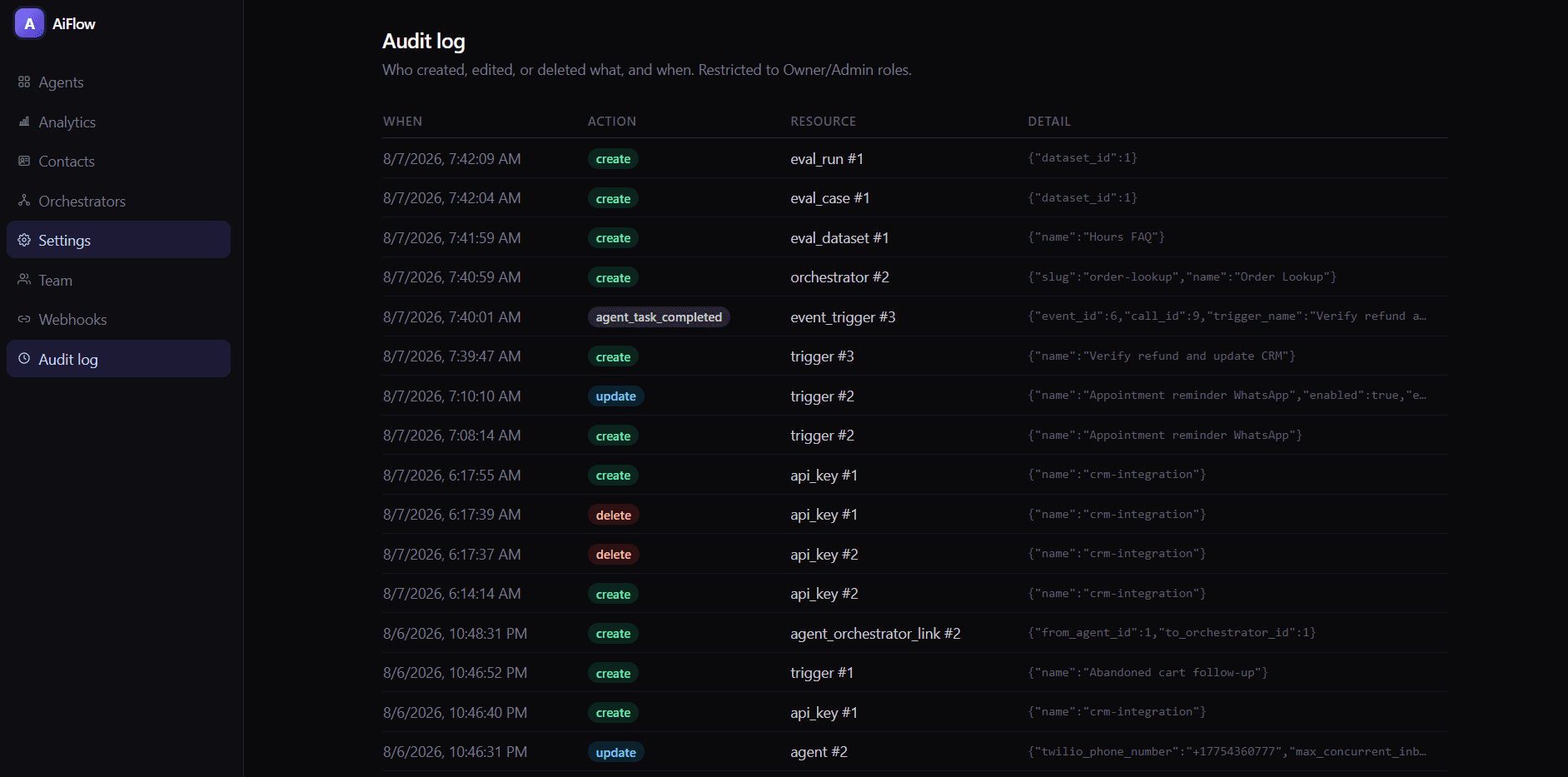
Who changed what, and when
Every meaningful administrative action, with who did it and when, including every call an outside MCP client makes. Read alongside the event log and the per-turn transcripts, it answers the question a regulated buyer actually asks, which is not what the system did but why it did it to that particular person.
- Never purged, unlike transcripts and events
- Readable by owners and admins only
What it deliberately does not do.
- Roles are deployment-wide. There is no organisation or workspace separation inside one deployment, because a deployment is one business.
- Rate limiting is per process, which is a consequence of running as a single instance.
- We hold no certification on your behalf. Self-hosting means the compliance posture is yours, which is the point for most buyers who ask.